Deprecated: Function get_magic_quotes_gpc() is deprecated in /home/jpic/philosophyofjazz.net/w/includes/WebStart.php on line 37
Warning: Cannot modify header information - headers already sent by (output started at /home/jpic/philosophyofjazz.net/w/includes/WebStart.php:37) in /home/jpic/philosophyofjazz.net/w/includes/WebStart.php on line 50
Warning: "continue" targeting switch is equivalent to "break". Did you mean to use "continue 2"? in /home/jpic/philosophyofjazz.net/w/includes/json/FormatJson.php on line 397
Warning: session_name(): Cannot change session name when headers already sent in /home/jpic/philosophyofjazz.net/w/includes/Setup.php on line 657
Warning: "continue" targeting switch is equivalent to "break". Did you mean to use "continue 2"? in /home/jpic/philosophyofjazz.net/w/languages/LanguageConverter.php on line 694
Warning: Parameter 2 to Cite::checkRefsNoReferences() expected to be a reference, value given in /home/jpic/philosophyofjazz.net/w/includes/Hooks.php on line 201
Warning: Parameter 2 to Cite::checkRefsNoReferences() expected to be a reference, value given in /home/jpic/philosophyofjazz.net/w/includes/Hooks.php on line 201
Warning: Parameter 2 to Cite::checkRefsNoReferences() expected to be a reference, value given in /home/jpic/philosophyofjazz.net/w/includes/Hooks.php on line 201
Warning: Parameter 2 to Cite::checkRefsNoReferences() expected to be a reference, value given in /home/jpic/philosophyofjazz.net/w/includes/Hooks.php on line 201
Warning: Cannot modify header information - headers already sent by (output started at /home/jpic/philosophyofjazz.net/w/includes/WebStart.php:37) in /home/jpic/philosophyofjazz.net/w/includes/WebResponse.php on line 37
Warning: Cannot modify header information - headers already sent by (output started at /home/jpic/philosophyofjazz.net/w/includes/WebStart.php:37) in /home/jpic/philosophyofjazz.net/w/includes/WebResponse.php on line 37
Warning: Cannot modify header information - headers already sent by (output started at /home/jpic/philosophyofjazz.net/w/includes/WebStart.php:37) in /home/jpic/philosophyofjazz.net/w/includes/WebResponse.php on line 37
Warning: Parameter 2 to Cite::checkRefsNoReferences() expected to be a reference, value given in /home/jpic/philosophyofjazz.net/w/includes/Hooks.php on line 201
Warning: Parameter 2 to Cite::checkRefsNoReferences() expected to be a reference, value given in /home/jpic/philosophyofjazz.net/w/includes/Hooks.php on line 201 DTOI Bibliography Bakup Oct 8 2023 - PhilosophyOfJazz.net
Revision as of 16:20, 8 October 2023 by Dr.davidcring(Talk | contribs)(Created page with "<!-- wp:heading {"textAlign":"center","level":1} --> <h1 class="wp-block-heading has-text-align-center"><strong>Bibliography for Descartes's theory of ideas</strong></h1> <!--...")
<img class="wp-image-550" style="width: 1000px;" src="" alt="A framed color graphic of the sideways cutout of a brain facing left labeled with many categories found in Descartes's theory of ideas.">
<img class="wp-image-220" style="width: 28px;" src="" alt="A flaming yellow, black, and white star used as a bullet point."> [AT] <a href="http://philosophyfaculty.ucsd.edu/faculty/ctolley/texts/descartes.html" data-type="link" data-id="http://philosophyfaculty.ucsd.edu/faculty/ctolley/texts/descartes.html">Oeuvres de Descartes</a> 13 volumes. Edited by Charles Adam and Paul Tannery. Paris: initially published in 1887–1913 and 1964–1978; Paris: Librairie Philosophique J. Vrin, 1996. This edition originally published in 1904. References are to volume and page number.
Click on screenshot below to access the displayed hyperlinks to those documents. To return to <a href="https://drdavidcring.net/descartes-ideas/2023/09/04/dtoi-bibliography/" data-type="post" data-id="190">DTOI BIBLIOGRAPHY</a>, click on your back arrow where they might look like this <img class="wp-image-247" style="width: 41px;" src="" alt="A black graphic inage of a curved and pointing to the left back arrow used to return to your previous URL."> or this <img class="wp-image-246" style="width: 20px;" src="" alt="A black graphic image of a pointed to left pinnacle of a right angled figure like a triangle pointing left with the base line missing used to return to your previous URL.">, or likely this <img class="wp-image-404" style="width: 32px;" src="" alt="A black graphic image of an arrow with straight lines facing left used as a clickable back arrow for returning to previous URL.">.
<img class="wp-image-220" style="width: 28px;" src="" alt="A flaming yellow, black, and white star used as a bullet point."> Bennett, Jonathan. <a href="https://earlymoderntexts.com/assets/pdfs/descartes1648.pdf">Conversation with Burman</a>. EarlyModernTexts.com, 2018.
<img class="wp-image-354" style="width: 1000px;" src="" alt="A colorful framed graphic of three cans of a drink called Vibe with categories from Descartes's theory of ideas printed on the cans.">
<figure class="wp-block-image aligncenter size-large is-resized"><a href=""><img src="" alt="A framed color drawing of Descartes standing at a lectern/table in a library with four soldiers to his left used as an advertising promotion for the DTOI website." class="wp-image-893" style="width:832px;height:671px" width="832" height="671"/></a></figure>
ABSTRACT: In this paper I sketch and defend three theses. The first is that for Descartes there is a distinction between a sensation and an idea of a sensation. Sensations are qualia, and ideas of sensations are ideas of qualia. The second thesis is that ideas of sensations are ideas and so have objective reality and are representational. A Cartesian sensation is a mode of mind but not an idea. If it is representational, it is not representational in virtue of having objective reality but in virtue of something else. The third thesis is that some of the confusion surrounding the issue of Cartesian sensations is due to Descartes' sometimes interchangeable use of the language of 'sensations' and the language of sensory 'ideas'.
<img class="wp-image-712" style="width: 1000px;" src="" alt="An advertising banner for the DTOI website consisting of a framed color photograph of a short suspension bridge leading into the jungle with prominent categories found in Descartes's theory of ideas sticking up along either side of the suspension wires.">
<a href="https://philpapers.org/rec/DERCS" data-type="link" data-id="https://philpapers.org/rec/DERCS">ABSTRACT</a>: Descartes maintained that sensations of color and the like misrepresent the material world in normal circumstances. Some prominent scholars have argued that, to explain this Cartesian view, we must attribute to Descartes a causal account of sensory representation. I contend that neither the arguments motivating this reading nor the textual evidence offered in its support is sufficient to justify such attribution. Both textual and theoretical reasons point in the direction of an (at least partial) internalist account of Descartes’ views on sensory representation.
Downing, Lisa. "Sensible Qualities and Material Bodies." In Primary and Secondary Qualities: The Historical and Ongoing Debate, edited by Lawrence Nolan, 109–35. Oxford, UK: Oxford University Press, 2011.
<img class="wp-image-339" style="width: 1000px;" src="" alt="A framed graphic of thirty five thumbnail book covers in seven columns in color on a teal bacground.">
Maull, Nancy. "Cartesian Optics and the Geometrization of Nature." In Descartes: Philosophy, Mathematics, and Physics, edited by Stephen Gaukroger, 22–40. Englewood Cliffs, NJ: Barnes and Noble, 1980.
Menn, Stephen. "The Discourse on Method and the Tradition of Intellectual Autobiography." In The Blackwell Guide to Descartes' Meditations, edited by Stephen Gaukroger, 3–19. Malden, MA: Blackwell Publishing, 2006.
Menn, Stephen. "The Greatest Stumbling Block: Descartes’ Denial of Real Qualities." In Descartes and His Contemporaries: Meditations, Objections and Replies, edited by Roger Ariew and Marjorie Grene, 182–207. Chicago, IL: University of Chicago Press, 1995.
Morris, Katherine J. "Intermingling and Confusion." International Journal of Philosophical Studies 3 (1995): 290–97.
Nadal, Anna Pilar Ortín. "<a href="http://core.ac.uk/works/8513054" data-type="link" data-id="http://core.ac.uk/works/8513054">Mental activity in Descartes' causal-semantic model of sensory perception</a>." PhD diss, Philosophy, The University of Edinburgh, July 2018.
Newman, Lex. "Unmasking Descartes's case for the Bête Machine doctrine." Canadian Journal of Philosophy 31, no. 3 (2001): 389–426.
Nolan, Lawrence. "Descartes on What We Call ‘Color.’" In Primary and Secondary Qualities: The Historical and Ongoing Debate, edited by Lawrence Nolan, 81–108. Oxford, UK: Oxford University Press, 2011.
Normore, Calvin. "Meaning and Objective Being: Descartes and His Sources." In Essays on Descartes' Meditations, edited by Amelie Oksenberg Rorty, 223–41. Berkeley: University of California Press, 1986.
Normore, Calvin. "The Matter of Thought." In Representation and Objects of Thought in Medieval Philosophy, edited by Henrik Lagerlund, 117–33. Burlington, VT: Ashgate Publishing Co., 2007.
O'Neil, Brian E. Epistemological Direct Realism in Descartes. Albuquerque, NM: University of New Mexico Press, 1974.
Rozemond, Marleen. Descartes's Dualism. Cambridge, MA: Harvard University Press, 1998.
Rozemond, Marleen. "The Nature of the Mind." In The Cambridge History of Seventeenth-Century Philosophy, Vol. 2, edited by Daniel Garber and Michael Ayers, 953–1002. Cambridge: Cambridge University Press, 2002.
<img class="wp-image-212" style="width: 1000px;" src="" alt="An advertising banner of a framed color graphic of a radiological 3D picture of a brain in left profile with various concepts found prominently in Descartes's theory of ideas circulating around inside the brain.">
Schmaltz, Tad M. "Deflating Descartes's Causal Axiom." Oxford Studies in Early Modern Philosophy, 3 (2006): 1–31.
Schmaltz, Tad M. Descartes on Causation. Oxford, UK: Oxford University Press, 2008.
Schmaltz, Tad M. “Descartes on Innate Ideas, Sensation, and Scholasticism: The Reponse to Regius.” In Studies in Seventeenth-Century European Philosophy, edited by Michael A. Srewart, 33–74. Oxford: Clarendon Press, 1997.
Schmaltz, Tad M. "Malebranche's Cartesianism and Lockean Colors." History of Philosophy Quarterly 12 (1995): 387–403.
Schmaltz, Tad M. Malebranche's Theory of the Soul: A Cartesian Interpretation. New York: Oxford University Press, 1996.
Schmaltz, Tad M. Radical Cartesianism: The French Reception of Descartes. Cambridge: Cambridge University Press, 2002.
Sebba, Gregor. "Descartes' Debt to Teresa of Avila, or The Influence of the Vida de la Madre Teresa de Jesus on the Exercices Spirituels and the Meditations." Journal of the History of Ideas 48 (1987): 211–44.
Sellars, Wilfrid. "Being and Being Known." Proceedings of the American Catholic Philosophical Association 34 (1960): 28–49.
Sellars, Wilfrid. "Berkeley and Descartes: Reflections on the 'New Way of Ideas'." In Studies in Perception: Interpretation in the History of Philosophy and Science, edited by Peter K. Machamer and Robert G. Turnbull, 259–311. Columbus, OH: Ohio State University Press, 1977.
Sellars, Wilfrid. "Empiricism and the Philosophy of Mind." In Minnesota Studies in the Philosophy of Science, Vol. I., edited by Herbert Feigl and Michael Scriven, 253–329. Minneapolis, MN: University of Minnesota Press, 1956.
Sellars, Wilfrid. Kant and Pre-Kantian Themes: Lectures by Wilfrid Sellars. Edited by Pedro V. Amaral. Atascadero, CA: Ridgeview, 2002.
Sellars, Wilfrid. Kant’s Transcendental Metaphysics: Sellars’ Cassirer Lectures Notes and Other Essays. Edited by Jeffrey F. Sicha. Atascadero, CA: Ridgeview, 2002.
Sellars, Wilfrid. "Philosophy and the Scientific Image of Man." In Frontiers of Science and Philosophy, edited by Robert Colodny, 35–78. Pittsburgh: University of Pittsburgh Press, 1962.
Sellars, Wilfrid. Science and Metaphysics: Variations on Kantian Themes. The John Locke Lectures for 1965–66. London: Routledge & Kegan Paul, 1968.
Sencerz, Stefan. "Descartes on Sensations and Animal Minds." Philosophical Papers 9 (1990): 119–41.
Stich, Stephen, ed. Innate Ideas. Berkeley, CA: University of California Press, 1975.
<img class="wp-image-721" style="width: 1000px;" src="" alt="A framed color advertising graphic for DTOI website of a flowering branching tree with a female helmeted warrior to the right of the tree hold a scrolling bannner draping to left with the Latin words "Cartesii theoria idearum" written on it three times and prominent categories in the theory of ideas written on the tree.">
Voss, Stephen. "Descartes: The End of Anthropology." In The Cambridge Companion to Descartes, edited by John Cottingham, 273–305. Cambridge: Cambridge University Press, 1992.
Voss, Stephen, ed. Essays on the Philosophy and Science of René Descartes. Oxford, UK: Oxford University Press, 1993.
Wells, Norman J. "Descartes' Idea and its Sources." American Catholic Philosophical Quarterly 67, no. 4 (1993): 513–35.
Wells, Norman J. "Material Falsity in Descartes, Arnauld, and Suarez." Journal of the History of Philosophy 22 (1984): 25–50.
Wells, Norman J. "Objective Being: Descartes and His Sources." The Modern Schoolman 45 (1967–1968): 49–61.
Wells, Norman J. "Objective Reality of Ideas in Descartes, Caterus, and Suarez." Journal of the History of Philosophy 28, no. 1 (1990): 33–61.
Wells, Norman J. "The Problem of Material Falsity in Descartes's Early Philosophy." American Catholic Philosophical Quarterly 64 (1990): 171–90.
1998. "Descartes and Suarez on Secondary Qualities: A Tale of Two Readings." The Review of Metaphysics 51.3: 565-604.2006. Descartes on Material Falsity. New York, Peter Lang.
Wilson, Margaret D. "Descartes on Sense and 'Resemblance'." In <a href="https://philpapers.org/rec/WILIAM-2">Ideas and Mechanism: Essays on Early Modern Philosophy</a>, 10–25. Princeton, NJ: Princeton University Press, 1999.
Wilson, Margaret D. "History of Philosophy in Philosophy Today; and The Case of the Sensible Qualities." Philosophical Review 101, no. 1 (1992): 191–243.
Wolf-Devine, Celia. Descartes on Seeing: Epistemology and Visual Perception. Carbondale: Southern Illinois University Press, 1993.
Yolton, John W. "Descartes and Material Qualities." In The Cambridge Companion to Descartes, edited by John Cottingham, 273–305. Cambridge: Cambridge University Press, 1992.
<a href="https://philpapers.org/rec/CARSSC" data-type="link" data-id="https://philpapers.org/rec/CARSSC">AUTHOR's ABSTRACT</a>: One of the central assumptions made in much of contemporary philosophy of mind is that there is no appearance-reality distinction when it comes to sensory states. On this assumption, sensory states simply are as they seem: consciousness is an intrinsic property of sensory states—that is, all sensory states are conscious—and the consciousness of one’s own sensory states is never inaccurate. For a sensation to be felt as pain, for example, is for it to be pain. This assumption, which I call the Cartesian assumption, can be seen everywhere from the standard arguments against physicalism—such as those advanced by Kripke, Nagel, and Levine—to current theorizing about consciousness. I here argue that this assumption is false and that it goes wrong in two ways. I further argue that the appeal of the Cartesian assumption is due to a commitment many still have to a poorly motivated and misguided Cartesian model of consciousness and its relation to mental states. As an alternative to this Cartesian concept of mind, I argue for a theory of consciousness which claims that the “phenomenal character” of a sensation or perception—the “what it’s like” to have that sensation—is determined by the content of a higher-order thought one has of that sensory state.
<a href="https://www.scribd.com/document/190305090/Nathan-Smith-and-Jason-Taylor-Descartes-and-Cartesianism-2005" data-type="link" data-id="https://www.scribd.com/document/190305090/Nathan-Smith-and-Jason-Taylor-Descartes-and-Cartesianism-2005">EDITORS'S INTRODUCTION</a>: In “Sensory States, Consciousness, and the Cartesian Assumption,” Gregg Caruso approaches the res cogitans from the concerns of contemporary philosophy of mind, investigating, specifically, the relationship between sensation and consciousness. Carouso challenges, the assumption, which he calls the "Cartesian assumption," that the range of sensation is co-extensive with consciousness: to have a sensation is to be aware of having a sensation. With examples from both ordinary experience and cognitive science, Carouso argues that this assumption can be undermined in two ways. First, we can have real sensations, which do not appear to us as sensations. Second, we can appear to have sensations which are not really sensations for us. Caruso concludes by offering an alternative theory of mind, the HOT (Higher Order Thought) model, which he believes more adequately represents the variety of our experience.
<img class="wp-image-1050" style="width: 26px;" src="" alt="A transparent 28 pt. rainbow colored hexagon used as a bullet point."> Searle, John R., Intentionality. An Essay in the Philosophy of Mind. Cambridge: Cambridge University Press, 1983.
<img class="wp-image-1050" style="width: 26px;" src="" alt="A transparent 28 pt. rainbow colored hexagon used as a bullet point."> Thompson, Evan. Colour Vision: A Study in Cognitive Science and the Philosophy of Perception. New York: Routledge, 1995
<img class="wp-image-1050" style="width: 26px;" src="" alt="A transparent 28 pt. rainbow colored hexagon used as a bullet point.">
<img class="wp-image-1050" style="width: 26px;" src="" alt="A transparent 28 pt. rainbow colored hexagon used as a bullet point.">
<img class="wp-image-1050" style="width: 26px;" src="" alt="A transparent 28 pt. rainbow colored hexagon used as a bullet point.">
<img class="wp-image-1050" style="width: 26px;" src="" alt="A transparent 28 pt. rainbow colored hexagon used as a bullet point.">
<img class="wp-image-1050" style="width: 26px;" src="" alt="A transparent 28 pt. rainbow colored hexagon used as a bullet point.">
<img class="wp-image-1050" style="width: 26px;" src="" alt="A transparent 28 pt. rainbow colored hexagon used as a bullet point.">
<img class="wp-image-1050" style="width: 26px;" src="" alt="A transparent 28 pt. rainbow colored hexagon used as a bullet point.">
<img class="wp-image-1050" style="width: 26px;" src="" alt="A transparent 28 pt. rainbow colored hexagon used as a bullet point.">
<img class="wp-image-1050" style="width: 26px;" src="" alt="A transparent 28 pt. rainbow colored hexagon used as a bullet point.">
<img class="wp-image-1050" style="width: 26px;" src="" alt="A transparent 28 pt. rainbow colored hexagon used as a bullet point.">
below not ordered right
Cottingham , John . 1990 . “ Descartes on Colour ,” Proceedings of the Aristotelian Society , n.s., 90 : 231–46 .
Des Chene , Dennis . 1996 . Physiologia . Ithaca : Cornell University Press .
Downing , Lisa . 2011 . “ Sensible Qualities and Material Bodies ,” in Primary and Secondary Qualities: The Historical and Ongoing Debate , ed. L. Nolan . Oxford : Oxford University Press , 109–35 .
Garber , Daniel . 1992 . Descartes’ Metaphysical Physics . Chicago : University of Chicago Press .
Gaukroger , Stephen . 1995 . Descartes: An Intellectual Biography . Oxford : Clarendon Press .
Jolley , Nicholas . 1990 . The Light of the Soul: Theories of Ideas in Leibniz, Malebranche, and Descartes . Oxford : Clarendon Press .
Menn , Stephen . 1995 . “ The Greatest Stumbling Block: Descartes’ Denial of Real Qualities ,” in Descartes and His Contemporaries: Meditations, Objections and Replies , ed. R. Ariew and M. Grene . Chicago : University of Chicago Press , 182 – 207 .
Nelson , Alan . 1996 . “ The Falsity in Sensory Ideas: Descartes and Arnauld ,” in Interpreting Arnauld , ed. E. Kremer . Toronto : University of Toronto Press , 13 – 32 .
Nolan , Lawrence . 2011 . “ Descartes on What We Call ‘Color,’ ” in Primary and Secondary Qualities: The Historical and Ongoing Debate , ed. L. Nolan . Oxford : Oxford University Press , 81 – 108 .
Nolan , Lawrence, and John Whipple . 2006 . “ The Dustbin Theory of Mind: A Cartesian Legacy? ,” Oxford Studies in Early Modern Philosophy 3 : 33 – 55 .
Schmaltz , Tad M . 1995 . “ Malebranche’s Cartesianism and Lockean Colors ,” History of Philosophy Quarterly 12 : 387 – 403 .
Wilson , Margaret . 1992 . “ History of Philosophy in Philosophy Today; and the Case of the Sensible Qualities ,” Philosophical Review 101 : 191 – 243 .
1978 . Descartes . London : Routledge & Kegan Paul .
Wolf-Devine , Celia . 1993 . Descartes on Seeing: Epistemology and Visual Perception . Carbondale : Southern Illinois University Press .
Descartes on Epistemology by Lex Newmsn
Adams, Robert, 1975. “Where Do Our Ideas Come From? – Descartes vs. Locke,” Innate Ideas, ed. Stephen P. Stich, Berkeley: University of California Press.
Alanen, Lilli, 2003. Descartes’s Concept of Mind, Harvard University Press.
–––, 2014. “The Second Meditation and the Nature of the Human Mind,” in The Cambridge Companion to Descartes’ Meditations, ed. David Cunning, Cambridge: Cambridge University Press.
Alston, William, 1989. Epistemic Justification, Ithaca: Cornell University Press.
Arnauld, Antoine, 1964. The Art of Thinking: Port-Royal Logic, tran. J. Dickhoff and P. James, New York: Library of Liberal Arts.
Audi, Robert, 1993. The Structure of Justification, Cambridge: Cambridge University Press.
–––, 2001. “Doxastic Voluntarism and the Ethics of Belief,” in Knowledge, Truth, and Duty, ed. Matthias Steup, Oxford: Oxford University Press.
Ayers, Michael, 1998. “Theories of Knowledge and Belief,” in The Cambridge History of Seventeenth Century Philosophy (Volume 2), ed. Daniel Garber and Michael Ayers, Cambridge: Cambridge University Press.
Bennett, Jonathan, 1990. “Truth and Stability in Descartes’ Meditations,” Canadian Journal of Philosophy (Supplement), 16: 75–108.
Beyssade, Michelle, 1993. “Privileged Truth or Exemplary Truth?” in Essays on the Philosophy and Science of René Descartes, ed. Stephen Voss, Oxford: Oxford University Press.
Bouwsma, O. K., 1949. “Descartes’ Evil Genius,” Philosophical Review, 58: 141–151.
Broughton, Janet, 2002. Descartes’s Method of Doubt, Princeton: Princeton University Press.
–––, 2008. “Self-Knowledge,” in A Companion to Descartes, ed. J. Broughton and J. Carriero, Oxford: Blackwell.
Carriero, John, 2009. Between Two Worlds: A Reading of Descartes’ Meditations, Princeton: Princeton University Press.
–––, 2008. “The Cartesian Circle and the Foundations of Knowledge,” in A Companion to Descartes, ed. J. Broughton and J. Carriero, Oxford: Blackwell.
Chappell, Vere, 1986. “The Theory of Ideas,” in Essays on Descartes’ Meditations, ed. Amélie Oksenberg Rorty, Berkeley: University of California Press.
Chisholm, Roderick M., 1982. The Foundations of Knowing, Minneapolis: University of Minnesota Press.
Clarke, Desmond M., 2006. “Descartes’ Proof of the Existence of Matter,” in The Blackwell Guide to Descartes’ Meditations, ed. Stephen Gaukroger, Oxford: Blackwell Publishing.
Cottingham, John, 1986. “Descartes, Sixth Meditation: The External World, Nature and Human Experience,” Philosophy (Supplement), 20: 73–89.
Cunning, David, 2007. “Descartes on the Dubitability of the Existence of Self,” Philosophy & Phenomenological Research, 74 (March): 111–131.
–––, 2010. Argument and Persuasion in Descartes’ Meditations, Oxford: Oxford University Press.
–––, 2014. “The First Meditation: Divine Omnipotence, Necessary Truths, and the Possibility of Radical Deception,” in The Cambridge Companion to Descartes’ Meditations, ed. David Cunning, Cambridge: Cambridge University Press.
Curley, E. M., 1978. Descartes Against the Sceptics, Cambridge, MA: Harvard University Press.
–––, 1986. “Analysis in the Meditations: The Quest for Clear and Distinct Ideas,” in Essays on Descartes’ Meditations, ed. Amélie Oksenberg Rorty, Berkeley: University of California Press.
–––, 1993. “Certainty: Psychological, Moral, and Metaphysical,” in Essays on the Philosophy and Science of René Descartes, ed. Stephen Voss, Oxford: Oxford University Press.
–––, 2006. “The Cogito and the Foundations of Knowledge,” in The Blackwell Guide to Descartes’ Meditations, ed. Stephen Gaukroger, Oxford: Blackwell.
Della Rocca, Michael, 2005. “Descartes, the Cartesian Circle, and Epistemology Without God,” Philosophy and Phenomenological Research, 70 (January): 1–33.
–––, 2006. “Judgment and Will,” in The Blackwell Companion to Descartes’ Meditations, ed. Stephen Gaukroger, Oxford: Blackwell Publishing.
–––, 2011. “Taking the Fourth: Steps toward a New (Old) Reading of Descartes,” Midwest Studies in Philosophy, 35: 93–110.
Dicker, Georges, 1993. Descartes: An Analytical and Historical Introduction, Oxford: Oxford University Press.
Dunlop, Charles E. M., ed. Philosophical Essays on Dreaming. Ithaca: Cornell University Press, 1977.
Euclid. The Thirteen Books of Euclid’s Elements, ed. Thomas L. Heath, New York: Dover Publications, 1956.
Frankfurt, Harry, 1966. “Descartes’s Discussion of His Existence in the Second Meditation, ” Philosophical Review, 75: 329–56.
–––, 1970. Demons, Dreamers, and Madmen, Indianapolis: The Bobbs-Merrill Company.
–––, 1978. “Descartes on the Consistency of Reason,” in Descartes: Critical and Interpretive Essays, ed. M. Hooker, Johns Hopkins University Press.
Friedman, Michael, 1997. “Descartes on the Real Existence of Matter,” Topoi, 16: 153–162.
Galileo, 1967. Dialogue Concerning the Two Chief World Systems, tran. Stillman Drake, Berkeley: University of California Press.
Garber, Daniel, 1986. “Semel in vita: The Scientific Background to Descartes’ Meditations,” in Essays on Descartes’ Meditations, ed. Amélie Oksenberg Rorty, Berkeley: University of California Press.
–––, 1992. Descartes’ Metaphysical Physics, Chicago: University of Chicago Press.
Gaukroger, Stephen, 1989. Cartesian Logic: An Essay on Descartes’s Conception of Inference, Oxford: Clarendon Press.
Gouhier, Henri, 1937. Essais sur Descartes, Paris: Vrin.
Hacking, Ian, 1980. “Proof and Eternal Truths: Descartes and Leibniz,” in Descartes: Philosophy, Mathematics and Physics, ed. Stephen Gaukroger, Sussex: The Harvester Press.
Hatfield, Gary, 1986. “The Senses and the Fleshless Eye: The Meditations as Cognitive Exercises,” in Essays on Descartes’ Meditations, ed. Amélie Oksenberg Rorty, Berkeley: University of California Press.
–––, 2006. “The Cartesian Circle” in The Blackwell Guide to Descartes’ Meditations, ed. Stephen Gaukroger, Oxford: Blackwell Publishing.
Hintikka, Jaakko, 1962. “Cogito ergo sum: Inference or Performance?” Philosophical Review, 71: 3–32.
–––, 1978. “A Discourse on Descartes’s Method,” in Descartes: Critical and Interpretive Essays, ed. Michael Hooker, Baltimore: Johns Hopkins University Press.
Hoffman, Paul, 1996. “Descartes on Misrepresentation,” Journal of the History of Philosophy, 34 (July): 357–381.
Jolley, Nicholas, 1990. The Light of the Soul: Theories of Ideas in Leibniz, Malebranche, and Descartes, Oxford: Clarendon Press.
–––, 2013. Causality and Mind: Essays on Early Modern Philosophy, Oxford: Oxford University Press.
Kenny, Anthony, 1968. Descartes: A Study of His Philosophy, New York: Random House.
Larmore, Charles, 2006. “Descartes and Skepticism,” in The Blackwell Guide to Descartes’ Meditations, ed. Stephen Gaukroger, Oxford: Blackwell Publishing.
–––, 2014. “The First Meditation: Skeptical Doubt and Certainty,” in The Cambridge Companion to Descartes’ Meditations, ed. David Cunning, Cambridge: Cambridge University Press.
Lennon, Thomas M., 2008. The Plain Truth: Descartes, Huet, and Skepticism, Leiden: Brill.
–––, 2014. “The Fourth Meditation: Descartes’ theodicy avant la lettre,” in The Cambridge Companion to Descartes’ Meditations, ed. David Cunning, Cambridge: Cambridge University Press.
Loeb, Louis E. 1992. “The Cartesian Circle,” in The Cambridge Companion to Descartes, ed. John Cottingham, Cambridge: Cambridge University Press.
LoLordo, Antonia. 2005. “Descartes and Malebranche on Thought, Sensation, and the Nature of the Mind,” Journal of the History of Philosophy, 43: 387–402.
–––, 2018. “Theories of Sense Perception,” in The Routledge Companion to Seventeenth Century Philosophy, ed. Dan Kaufman, London: Routledge. (Scholar) Markie, Peter, 1992. “The Cogito and Its Importance,” in The Cambridge Companion to Descartes, ed. John Cottingham, Cambridge: Cambridge University Press.
McRae, Robert, 1972. “Descartes’ Definition of Thought,” in Cartesian Studies, ed. R. J. Butler, Oxford: Blackwell.
Menn, Stephen, 1998. Descartes and Augustine, Cambridge: Cambridge University Press.
Moore, G. E., 1962. Philosophical Papers, New York: Collier Books.
Morris, John, 1973. “Descartes’ Natural Light,” Journal of the History of Philosophy, 11: 169–187.
Nadler, Steven, 2006. “The Doctrine of Ideas,” in The Blackwell Guide to Descartes’ Meditations, ed. Stephen Gaukroger, Oxford: Blackwell Publishing.
–––, 2018. “Consciousness,” in The Routledge Companion to Seventeenth Century Philosophy, ed. Dan Kaufman, London: Routledge.
Nelson, Alan, 1997. “Descartes’s Ontology of Thought,” Topoi, 16: 163–178.
–––, 2007. “Cartesian Innateness,” in A Companion to Descartes, ed. Janet Broughton and John Carriero, Oxford: Blackwell.
–––, 2018. “Logic and Knowledge,” in The Routledge Companion to Seventeenth Century Philosophy, ed. Dan Kaufman, London: Routledge.
Newman, Lex. "Descartes on Unknown Faculties and Our Knowledge of the External World." Philosophical Review 103 (July 1994): 489–531.
–––, 2004. “Rocking the Foundations of Cartesian Knowledge: Critical Notice of Janet Broughton, Descartes’s Method of Doubt,” Philosophical Review, 113: 101–125.
–––, 2006. “Descartes’ Rationalist Epistemology,” in A Companion to Rationalism, ed. Alan Nelson, Oxford: Blackwell.
–––, 2007. “Descartes on the Will in Judgment,” in A Companion to Descartes , ed. Janet Broughton and John Carriero, Oxford: Blackwell.
–––, 2009. “Ideas, Pictures, and the Directness of Perception in Descartes and knowledge,” Philosophy Compass, 4: 134–54.
–––, 2011. “Sensory Doubts and the Directness of Perception in the Meditations,” Midwest Studies in Philosophy, 35.
–––, 2012. “Frankfurt and the Cartesian Circle,” in Debates in Modern Philosophy: The Essential Readings, ed. A. LoLordo and S. Duncan, London: Routledge.
–––, 2019. “Descartes on the Method of Analysis,” in The Oxford Handbook of Descartes and Cartesianism, ed. S. Nadler, T. M. Schmaltz, and D. Antoine-Mahut, Oxford: Oxford University Press.
Newman, Lex, and Alan Nelson, 1999. “Circumventing Cartesian Circles,” Noûs, 33: 370–404.
Nolan, Lawrence, 2005. “The Ontological Argument as an Exercise in Cartesian Therapy,” Canadian Journal of Philosophy, 35: 521–62.
–––, 2014. “The Third Meditation: Causal Arguments for God’s Existence,” in The Cambridge Companion to Descartes’ Meditations, ed. David Cunning, Cambridge: Cambridge University Press.
Nolan, Lawrence, and Alan Nelson, 2006. “Proofs for the Existence of God,” in The Blackwell Guide to Descartes’ Meditations, ed. Stephen Gaukroger, Oxford: Blackwell.
Nolan, Lawrence, and John Whipple, 2005. “Self-Knowledge in Descartes and Malebranche,” Journal of the History of Philosophy, 32: 55–82.
Peacocke, Christopher, 2012. “Cogito Ergo Sum: Descartes Defended,” Proceedings of the Aristotelian Society (Supplementary Volume) 86: 109–25.
Peirce, Charles, 1955. Philosophical Writings of Peirce, ed. Justus Buchler, New York: Dover Publications.
Plantinga, Alvin, 1993. Warrant: The Current Debate, Oxford: Oxford University Press.
Popkin, Richard H., 1979. The History of Scepticism from Erasmus to Spinoza, Berkeley: University of California Press.
Radner, Daisie, 1988. “Thought and Consciousness in Descartes,” Journal of the History of Philosophy 26: 439–52.
Ragland, C. P. and Everett Fulmer, 2017. “Against the New Cartesian Circle,” Canadian Journal of Philosophy 47: 66–74.
Rickless, Samuel C., 2005. “The Cartesian Fallacy Fallacy,” Noûs, 39: 309–336.
Rozemond, Marleen, 2006. “The Nature of the Mind,” in The Blackwell Guide to Descartes’ Meditations, ed. Stephen Gaukroger, Oxford: Blackwell.
Russell, Bertrand, 1945. A History of Western Philosophy, New York: Simon and Schuster.
Sarkar, Husain, 2003. Descartes’ Cogito: Saved from the Great Shipwreck, Cambridge: Cambridge University Press.
Schmitt, Frederick F., 1986 “Why was Descartes a Foundationalist?”, in Essays on Descartes’ Meditations, ed. Amélie Oksenberg Rorty, Berkeley: University of California Press.
–––, 2014. “Sensory Perception of Bodies: Meditation 6.5,” in The Cambridge Companion to Descartes’ Meditations, ed. David Cunning, Cambridge: Cambridge University Press.
Smith, Kurt, 2010. Matter Matters: Metaphysics and Methodology in the Early Modern Period, Oxford: Oxford University Press.
Sosa, Ernest, 1997a. “How to Resolve the Pyrrhonian Problematic: A Lesson from Descartes,” Philosophical Studies, 85: 229–49.
–––, 1997b. “Reflective Knowledge in the Best Circles,” Journal of Philosophy, 94 (August): 410–430.
–––, 1980. “The Raft and the Pyramid: Coherence versus Foundations in the Theory of Knowledge,” Midwest Studies in Philosophy, 5: 3–26.
Stroud, Barry, 2008. “Our Debt to Descartes,” in A Companion to Descartes, ed. Janet Broughton and John Carriero, Oxford: Blackwell.
Van Cleve, James, 1979. “Foundationalism, Epistemic Principles, and the Cartesian Circle,” Philosophical Review, 88 (Jan): 55–91.
Vendler, Zeno, 1972. Res Cogitans: An Essay in Rational Psychology, Ithaca: Cornell University Press. (Scholar) –––, 1984. The Matter of Minds, Oxford: Oxford University Press.
Vinci, Thomas C., 1998. Cartesian Truth, Oxford: Oxford University Press.
Wagner, Stephen I., 2014. Squaring the Circle in Descartes’ Meditations: The Strong Validation of Reason, Cambridge: Cambridge University Press.
Wee, Cecilia, 2012. “Newman on the Proof of the External World in Descartes’s Meditations,” British Journal for the History of Philosophy, 9: 123–30.
Williams, Bernard, 1978. Descartes: The Project of Pure Enquiry, New York: Penguin.
–––, 1983. “Descartes’s Use of Skepticism,” in The Skeptical Tradition, ed. Myles Burnyeat, Berkeley: University of California Press.
Williams, Michael, 1986. “Descartes and the Metaphysics of Doubt,” in Essays on Descartes’ Meditations, ed. Amélie Oksenberg Rorty, Berkeley: University of California Press.
–––, 1995. Unnatural Doubts: Epistemological Realism and the Basis of Scepticism, Princeton: Princeton University Press.
Beck, L. J., 1965, The Metaphysics of Descartes: A Study of the Meditations, Oxford: Clarendon Press.
Bolton, Martha Brandt, 2013, "Thinking—The Nature of Descartes' Mental Substance," in Detlefsen (ed.) 2013b: 64-81. doi:10.1017/CB09781139030731.008
Brown, Deborah J. and Calvin G. Normore, 2019, Descartes and the Ontology of Everyday Life, Oxford: Oxford University Press. doi:10.1093/oso/9780198836810.001.0001
Hatfield, Gary, 2015, "On Natural Geometry and Seeing Distance Directly in Descartes", in Mathematizing Space: The Objects of Geometry from Antiquity to the Early Modern Age, Vincenzo De Risi (ed.), (Trends in the History of Science), Chain- Springer International Publishing, 157-191. doi:10.1007/978-3-319-12102-4_7
Nolan, Lawrence, 2011a, "Descartes on 'What We Call Color', in Nolan (ed.) 2011b: 81— 108 (ch. 4). (ed.), 2011b, Primary and Secondary Qualities: The Historical and Ongoing Debate, Oxford/New York: Oxford University Press. doi:10.1093/acprof:oso/9780199556151.001.0001
Ortin Nadal, Anna, 2019, "Descartes on the Distinction between Primary and Secondary Qualities," British Journal for the History of Philosophy, 27(6): 1113—1134. doi:10.1080/09608788.2019.1568227
Pasnau, Robert, 2007, "Democritus and Secondary Qualities", Archiv Fiir Geschichte Der Philosophie, 89(2): 99-121. doi:10.1515/AGPH.2007.006 , 2011, "Scholastic Qualities, Primary and Secondary", in Nolan (ed.) 2011b: 41-61.
Patterson, Sarah, 2007, "Clear and Distinct Perception", in A Companion to Descartes, Janet Broughton and John Carriero (eds.), Malden, MA/Oxford: Blackwell, 216-234. doi:10.1002/9780470696439.ch13
Paul, Elliot Samuel and John Morrison, 2014, "Review of Descartes and the Puzzle of Sensory Representation, by Raffaella De Rosa", Mind, 123(492): 1187-1191. doi:10.1093/mind/fzu158
Piccolino, Marco and Nicholas J Wade, 2008, "Galileo's Eye: A New Vision of the Senses in the Work of Galileo Galilei", Perception, 37(9): 1312-1340. doi:10.1068/p6011 [IHM] Reid, Thomas, 1764 [1997], An Inquiry into the Human Mind, Edinburgh. Reprinted Derek Brooks (ed.), University Park, PA: Pennsylvania University Press, 1997. [EIP] , 1785 [2002], Essays on the Intellectual Powers of Man, Dublin: L. White. Reprinted Derek Brookes (ed. and annotation) and Knud Haakonssen (annotation and Introduction), University Park, PA: Pennsylvania State Press, 2002. Rickless, Samuel Charles, 2014, Locke, (Blackwell Great Minds 14), Chichester, West Sussex: Wiley Blackwell. doi: 10.1002/9781118327685 Ross, Peter, 2015, "Primary and Secondary Qualities", in Oxford Handbook of Philosophy of Perception, Mohan Mathen (ed.), Oxford: Oxford University Press, 405-421.
Rozemond, Marleen, 1998, Descartes Dualism, Cambridge, MA: Harvard University Press.
Secada, Jorge, 2000, Cartesian Metaphysics: The Scholastic Origins of Modern Philosophy, Cambridge: Cambridge University Press. doi:10.1017/CB09780511487309
Schmaltz, Tad M., 1992, "Sensation, Occasionalism and Descartes' Causal Principle", in Cummins and Zoeller 1992: 37-56.
Simmons, Alison J, 2001, "Sensible Ends: Latent Teleology in Descartes' Account of Sensation", Journal of the History of Philosophy, 39(1): 49-75. doi:10.1353/hph.2003.0085
Simmons, Alison J, 2001, "Sensible Ends: Latent Teleology in Descartes' Account of Sensation", Journal of the History of Philosophy, 39(1): 49-75. doi:10.1353/hph.2003.0085
Simmons, Alison, 2003, "Descartes on the Cognitive Structure of Sensory Experience", Philosophy and Phenomenological Research, 67(3): 549-579. doi:10.1111/j.1933-1592.2003.tb00308.x
Vinci, Thomas C., 1998, Cartesian Truth, New York: Oxford University Press. doi: 10.1093/0195113292.001.0001
Wilson, Margaret Dauler, 1978, Descartes, (The Arguments of the Philosophers), London/Boston: Routledge & K. Paul. doi: 10.4324/9780203167670
Wilson, Margaret, 1990 [1999], "Descartes on the Representationality of Sensation", in Central Themes in Early Modern Philosophy: Essays Presented to Jonathan Bennett, J. A. Cover and Mark Kulstad (eds), Indianapolis, IN: Hacket, 1-22. Reprinted in Wilson 1999: 69-83.
Wilson, Margaret, 1992, "History of Philosophy in Philosophy Today; and the Case of the Sensible Qualities", The Philosophical Review, 101(1): 191-243. doi: 10.2307/2185046.
Wilson, Margaret, 1993 [1999], "Descartes on the Perception of Primary Qualities", in Essays on the Philosophy and Science of Rene Descartes, Stephen Voss (ed.), Oxford: Oxford University Press, 162–173. Reprinted in Wilson 1999: 26-40. doi:10.1093/acprof:oso/9780195075519.003.0012.
Wilson, Margaret, 1999, Ideas and Mechanism: Essays on Early Modern Philosophy, Princeton, NJ: Princeton University Press. doi: 10.1515/9781400864980.
===Cecilia Wee Bibliography===
162 Select bibliography
Alanen, L. (1994) ‘Sensory Ideas, Objective Reality and Material Falsity’, in J. Cottingham (ed. 1994), 229–50.
——(2003) Descartes’s Concept of Mind, Cambridge, MA: Harvard University Press.
Arbini, R. (1983) ‘Did Descartes have a Philosophical Theory of Sense Perception?’, Journal of the History of Philosophy, 21: 317–88.
Ariew, R. (1999) Descartes and the Last Scholastics, Ithaca, NY: Cornell University Press.
Ariew, R. and M. Grene (ed. 1995) Descartes and His Contemporaries: Meditations, Objections and Replies, Chicago: University of Chicago Press.
——(1995) ‘Ideas, In and Before Descartes’, Journal of the History of Philosophy, 56: 87–106. Armogathe, J-R (1979) ‘Vers un autre Descartes’, in Travaux récents sur le XVIIe siècle, 17: 189–98.
Bennett, J. (1994) ‘Descartes’s Theory of Modality’, Philosophical Review, 103: 639–67. Beyssade, J.M. (1992) ‘Descartes on Material Falsity’ in Minds, Ideas, and Objects: Essays on the Theory of Representation in Modern Philosophy, ed. Phillip D. Cummins and Guenter Zoeller, Atascadero, CA: Ridgeview Press, 5–20.
Bolton, M. (1986) ‘Confused and Obscure Ideas of Sense’, in A.O. Rorty (ed.), Essays on Descartes’ Meditations, Berkeley: University of California Press, 389–403.
Boros, G. (2001) ‘Ethics in an Age of Automata: Ambiguities in Descartes’s Concept of an Ethics’, History of Philosophy Quarterly, 18: 139–54.
Broughton, J. (2002) Descartes’s Method of Doubt, Princeton, NJ: Princeton University Press.
Calvert, B. (1972) ‘Descartes and the Problem of Evil’, Canadian Journal of Philosophy, 2: 117–26.
Carraud, V. (1987) ‘The Relevance of Cartesianism’ in Contemporary French Philosophy, ed. A. Phillips Griffiths, Cambridge and New York: Cambridge University Press.
Carriero, J. (1990) Descartes and the Autonomy of the Human Understanding, New York: Garland.
Chappell, V. (1986) ‘The Theory of Ideas’, in A.O. Rorty (ed.), Essays on Descartes’ Meditations, Berkeley: University of California Press, 177–98.
——(1999) The Causation Debate in Modern Philosophy 1637–1739, London and New York: Routledge.
Colish, M. (1984) ‘Carolingian Debates over “Nihil” and “Tenebrae”: a Study in Theological Method’, Speculum, 59: 757–95.
Costa, M. (1983) ‘What Cartesian Ideas Are Not’, Journal of the History of Philosophy 21: 237–8.
Cottingham, J. (1976) Descartes’ Conversation with Burman, Oxford: Clarendon Press.
——(1985) ‘Cartesian Trialism’, Mind, 94: 218–30.
——(1986) ‘Descartes’ “Sixth Meditation”: the External World, “Nature” and Human Experience’, Philosophy, 20, Supp: 73–8.
——(ed. 1992) The Cambridge Companion to Descartes, Cambridge and New York: Cambridge University Press.
——(1993) A Descartes Dictionary, Oxford: Blackwell.
——(ed. 1994) Reason, Will and Sensation: Studies in Descartes’s Metaphysics, Oxford: Clarendon Press, and New York: Oxford University Press.
——(1998) Philosophy and the Good Life: Reason and the Passions in Greek, in Cartesian and Psycholo-analytic Ethics, Cambridge and New York: Cambridge University Press.
Cronin, T. (1966) Objective Being in Descartes and in Suárez, Rome: Gregorian University Press; reprinted, New York: Garland, 1987.
Curley, E.M. (1978) Descartes Against the Skeptics, Cambridge, MA: Harvard University Press, and Oxford: Blackwell.
——(1984) ‘Descartes on the Creation of the Eternal Truths’, Philosophical Review, 93: 4, 569–97.
Davies, R. (2001) Descartes: Belief, Scepticism and Virtue, London and New York: Routledge.
De Rosa, Raffaella (2004) ‘Descartes on Sensory Misrepresentation: The Case of Materially False Ideas’, History of Philosophy Quarterly, 21: 3, 261–80.
Devillairs, L. (1998) Descartes, Leibniz: Les vérités éternelles, Paris: Presses Universitaires de France.
Dicker, G. (1993) Descartes: An Analytical and Historical Introduction, Oxford and New York: Oxford University Press.
Field, R.W. (1993) ‘Descartes on the Material Falsity of Ideas’, Philosophical Review, 102: 309–34.
Flage, D. and C. Bonnen (1999) Descartes and Method: A Search for a Method in Meditations, London and New York:
Frankfurt, H. (1970) Demons, Dreamers and Madmen: The Defense of Reason in Descartes’s Meditations, Indianapolis, IN: Bobbs-Merrill; reprinted, New York: Garland, 1987.
——(1977) ‘Descartes on the Creation of the Eternal Truths’, Philosophical Review, 86: 36–57.
Garber, Daniel. (1992) Descartes’ Metaphysical Physics, Chicago: University of Chicago Press.
—— Descartes Embodied: Reading Cartesian Philosophy through Cartesian Science, Cambridge and New York: Cambridge University Press, 2001.
Gaukroger, Stephen. "The Nature of Abstract Reasoning: Philosophical Aspects of Descartes’ Work in Algebra." In The Cambridge Companion to Descartes, translated by Stephen Gaukroger. Cambridge and New York: Cambridge University Press, 1992.
——(1995), Descartes: An Intellectual Biography, Oxford: Clarendon Press, and New York: Oxford University Press.
——(2002) Descartes’ System of Natural Philosophy, Cambridge and New York: Cambridge University Press.
Gilson, É. (1951) Études sur le rôle de la pensée médiévale dans la formation du système cartésien, Paris: Vrin (second edition; originally published 1930).
Grene, M. (1991) Descartes Among the Scholastics, Milwaukee, WI: Marquette University Press. Guéroult, M. (1953) Descartes selon l’ordre des raisons, 2 vols, Paris: Aubier; reprinted, Paris: Montaigne, 1968.
Guéroult, M. (1984–85) Descartes’ Philosophy Interpreted According to the Order of Reasons (trans.) R. Ariew, R. Ariew, and A. Donagan), 2 vols, Minneapolis: University of Minnesota Press (translation of Guéroult 1953).
Hatfield, G. and W. Epstein (1979) ‘The Sensory Core: The Medieval Foundations of Early Modern Perceptual Theory’, Isis, 70: 363–84.
Hick, J. (1966) Evil and the God of Love, New York: Harper and Row, and London: Macmillan.
Janowski, Z. (2000) Cartesian Theodicy: Descartes’ Quest for Certitude, Dordrecht: Kluwer.
the ——(2004) Augustinian Cartesian Index: Texts and Commentary, South Bend, IN: St Augustine’s Press.
Kenny, A.J.P. (1968) Descartes: A Study of his Philosophy, New York: Random House; reprinted, New York: Garland, 1987, and Bristol: Thoemmes Press, 1993.
Kirwan, C. (1989) Augustine, London and New York: Routledge; reprinted, 1999.
MacKenzie, A.W. (1990) ‘Descartes on Sensory Representation: A Study of the Dioptrics’, Canadian Journal of Philosophy, Supp. 16: 109–47.
Marion, J.-L. (1975) Sur l’ontologie grise de Descartes: science cartésienne et savoir aristotélicien dans les Regulae, Paris: Vrin; translated as Descartes’s Grey Ontology: Cartesian Science and Aristotelian Thought in the Regulae, South Bend, IN: St Augustine’s Press, 2004.
——(1981) Sur la théologie blanche de Descartes: analogie, création des vérités éternelles et fondement, Paris: Presses Universitaires de France.
——(1996) ‘A propos Suárez et Descartes’, Revue internationale de philosophie, 195: 109–31.
——(1999a) Cartesian Questions: Method and Metaphysics, Chicago: University of Chicago Press.
——(1999b) On Descartes’ Metaphysical Prism: The Constitution and the Limits of Onto-theo-logy in Cartesian Thought, trans J. L. Kosky, Chicago: University of Chicago Press.
Markie, P. (1986) Descartes’s Gambit, Ithaca: Cornell University Press.
——(1992) ‘The Cogito and its Importance’ in J. Cottingham (ed.), The Cambridge Companion to Descartes, Cambridge and New York: Cambridge University Press, 140–73.
Marshall, J. (1998) Descartes’s Moral Theory, Ithaca, NY: Cornell University Press.
Matthews, Gareth B. (1992), Thought’s Ego in Augustine and Descartes, Ithaca, NY: Cornell University Press.
Maull, N.L. (1978) ‘Cartesian Optics and the Geometrization of Nature’, Review of Metaphysics, 32: 253–73.
Menn, S. (1998) Descartes and Augustine, Cambridge and New York: Cambridge University Press.
Newman, L. (1994) ‘Unknown Faculties and Our Knowledge of the External World’, Philosophical Review, 103: 489–531.
——(1999) ‘The Fourth Meditation’ Philosophy and Phenomenological Research 59: 559–91.
Normore, C. (1986) ‘Meaning and Objective Being: Descartes and His Sources’ in A.O. Rorty (ed.), Essays on Descartes’ Meditations, Berkeley: University of California Press, 223–41.
O’Neill, E. (1987), ‘Mind–Body Interaction and Metaphysical Consistency: A Defense of Descartes’, Journal of the History of Philosophy, 25: 227–45.
——(1998) Descartes: His Life and Thought, trans. J.M. Todd, Ithaca, NY: Cornell University Press.
Rozemond, M. (1998) Descartes’s Dualism, Cambridge, MA: Harvard University Press.
Schmitter, Amy M. "Formal Causation and the Explanation of Intentionality in Descartes." Monist, 79 (1996): 368–87.
——(2002) ‘Descartes and the Primacy of Practice: The Role of the Passions in the Search for Truth’, Philosophical Studies, 106: 99–108.
Secada, J. (2000) Cartesian Metaphysics: The Late Scholastic Origins of Modern Philosophy, Cambridge and New York: Cambridge University Press.
Shapiro, L. (1999) ‘Princess Elizabeth and Descartes: The Union of Soul and Body and the Practice of Philosophy’, British Journal for the History of Philosophy, 7(3): 503–20.
Sievert, D. (1975) ‘Descartes’ Self-Doubt’ Philosophical Review, 84: 51–69.
Simmons, A. (1999) ‘Are Cartesian Sensations Representational?’, Nous, 33: 347–69.
——(2001), ‘Sensible Ends: Latent Teleology in Descartes’ Account of Sensation’, Journal of the History of Philosophy, 39: 49–75.
Taylor, C. (1989) Sources of the Self: The Making of the Modern Identity, Cambridge: Cambridge University Press, and Cambridge, MA: Harvard University Press.
Tierno, J.T. (1997) Descartes on God and Human Error, Atlantic Highlands, NJ: Humanities Press.
Vinci, T. (1998) Cartesian Truth, Oxford and New York: Oxford University Press.
Voss, Stephen, ed. Essays on the Philosophy and Science of René Descartes. Oxford and New York: Oxford University Press, 1993.
Watson, R.A. (1987) The Breakdown of Cartesian Metaphysics, Atlantic Highlands, NJ: Humanities Press.
Wee, Cecilia. "Descartes' Two Proofs of the External World." Australasian Journal of Philosophy, Vol. 80, no. 4 (2005): 487–501.
——(2005) ‘Material Falsity and the Arguments for God’s Existence in Descartes’s Meditations’, in J. Jenkins, J. Whiting, and C. Williams (eds), Persons and Passions: Essays in Honor of Annette Baier, Notre Dame, IN: University of Notre Dame Press.
——(forthcoming) ‘Descartes and Leibniz on Human Free-Will and the Ability to Do Otherwise’, Canadian Journal of Philosophy.
Wells, N. (1984) ‘Material Falsity in Descartes, Arnauld and Suárez’, Journal of the History of Philosophy, 22: 25–50.
——(1990) ‘Objective Reality of Ideas in Descartes, Caterus and Suárez’, Journal of the History of Philosophy, 28: 33–61.
Williams, B., Descartes: The Project of Pure Enquiry, Hassocks, Sussex: Harvester Press, and Atlantic Highlands, NJ: Humanities Press, 1978; revised edition, London and New York: Routledge, 2005.
Williston, B. (1997) ‘Descartes on Love and/as Error’, Journal of the History of Ideas, 58: 429–44.
Williston, B. and A. Gombay eds. Passion and Virtue in Descartes, Amherst, NY: Humanity, and Oxford: Lavis, 2003.
Wilson, Catherine. (2003) Descartes’s Meditations: An Introduction, Cambridge and New York: Cambridge University Press.
——(1999a), ‘Descartes on the Perception of Primary Qualities’, reprinted in her (1999b), 26–40.
——(1999b) Ideas and Mechanism: Essays in Early Modern Philosophy, Princeton: Princeton University Press.
===Cecilia Wee Footnotes===
Notes 153
Ch. 1 An Introduction to Descartes’s Materially False Ideas
See, for instance, Kenny 1968, Menn 1998, and Williams 1978. [where they briefly mention material falsity]
See, for instance, Dicker 1993, Gaukroger 1995, and Rodis-Lewis 1998. [where they do not even mention material falsity]
: [One dictionary on Descartes (Cottingham 1993) does not include materially false ideas as an entry; and a recent book on human error in Descartes (Tierno 1997) does not mention them at all. (see p. 2)]
An asterisk indicates that I have departed slightly from CSM’s translation of the given passage.
The point is made in Ariew and Grene 1995: 4.
A recent exception is Vinci 1998.
See, for instance, Ariew 1999, Ariew and Grene 1995, Carriero 1990, Gaukroger 1995, Grene 1991, Marion 1975, 1981, and 1999b, Menn 1998, Secada 2000, Rodis-Lewis 1998, and Rozemond 1998.
Recent books that make this distinction include Broughton 2002, Hatfield 2003, and Wilson 2003.
Ch. 2 ‘Static’ Interpretations of Materially False Ideas – A Survey
Normore obviously means by ‘false ideas’ materially false ideas. TMD, on which Normore bases his interpretation of what a false idea is, is concerned with material falsity in an idea. Note also that Bolton also uses the term ‘false ideas’ to denominate materially false ideas specifically.
Bolton too accepts that there is a distinction between reality and existence for Descartes, and that ideas may represent potentially real (but actually non-existing) objects.
Ch. 3 A ‘Dynamic’ Interpretation of Materially False Ideas
See, for instance, Cronin 1966, Marion 1996, Marion 1999b, Secada 2000, Wells 1984, and Wells 1990.
See, for instance, AT 8A: 17–19, CSM 1: 204–5; AT 7: 147–8, CSM 2: 105; and AT 7: 204, CSM 2: 270.
Descartes refers to material truth in AT 4: 685 and AT 7: 151, CSM 2: 107, although neither reference seems particularly helpful in understanding material truth with respect to ideas. I thank an anonymous reviewer for Routledge for pointing out the second reference.
I assume here that the conditions listed are necessary, but not sufficient (since one can plausibly maintain that other conditions might be necessary for true representation). It is possible, however, that Descartes took these conditions to be necessary and sufficient.
The one idea whose cause Descartes does know, and that ACP can get a grip on within Descartes’s epistemic constraints at this stage in the Meditations, is the idea of himself qua thinker. (After all, Descartes knows that he exists, and presumably knows he is the cause of his idea of himself.) Thus, whenever I discuss ACP as inapplicable to Descartes’s ideas, I mean to exclude his idea of himself.
Notes 154
It is not claimed here that ACP would be applicable to all ideas, even if an external world exists. For instance, ACP would not apply to invented ideas. (For instance, the invented idea of a mermaid is caused by the thinker’s inventive faculty, but one would not say the idea is false because it fails to represent its cause accurately). Thus, ACP would apply only to a certain class of ideas – those which purport to represent their causes. The point being made here is simply this: given that Descartes does not know if there is an external world, ACP cannot even be applied to this class of ideas.
Descartes states in the Causal Principle that he is seeking for the efficient cause of his ideas. However, commentators have engaged in some debate as to whether Descartes accepted causal dualism, and in particular, the position that his ‘sensory’ ideas may be efficiently caused by corporeal matter. Some have argued that he is an ‘occasionalist’ with respect to the mind–body relationship (see Clatterbaugh 1999: 17–45 for an excellent discussion). If Descartes thinks that physical occurrences occasion, rather than produce, his ‘sensory’ ideas, then he may be somewhat imprecise when he claims in the Causal Principle to be seeking for the efficient cause of his ideas. Thus, although the Causal Principle is concerned with the ‘efficient’ causes of Cartesian ideas, I do not rule out that such ‘efficient’ causation might involve occasional ‘causes’ rather than efficient causes as we would usually construe them (that is, as causes that directly ‘produce’ a particular effect). In other words, my claims in this book are neutral between the causal dualist and occasionalist positions on Cartesian mind–body relations. Again, when it is claimed that Descartes accepts ACP (the Accurate Causal Portrayal account of representation) in certain epistemic contexts, this does not rule out that the ‘efficient cause’ of an idea here could be what occasions the idea in the thinker.
See also AT 7: 45, CSM 2: 31; AT 7: 102–3, CSM 2: 74–5; and AT 7: 161, CSM 2:b114.
Fairly detailed treatments are found in, for instance, Cronin 1966, Secada 2000, and Wells 1990.
There are differences in commentators’ views about the kind of reality that the ideao has. For instance, Wells holds that the ideao is a true and immutable nature, whereas Kenny’s discussion indicates that he thinks that the ideao can be an existing thing such as the sun. Kenny also suggests that there is an inconsistency in Descartes’s treatment of ideao.
Commentators sometimes use the locution that ideam ‘have’ objective reality. But the actual term that Descartes uses is that ideam ‘contain’ objective reality (see Chappell 1986: 190).
See, for instance, Alanen 1994, Alanen 2003, Chappell 1986, and Guéroult 1984–5.
Descartes holds that an ideam may contain different levels or degrees of objective reality according to the thing represented in the idea. This suggests that the objective reality in an idea is not to be identified directly with the thing represented in the idea, since this would entail that these things have different degrees or levels. Rather, the ideam contains (a certain level of) objective reality in virtue of the thing represented.
One might, at this point, query the plausibility of Descartes’s claim that ideas that represent no things have no existing cause at all. Surely, such ideas must have some sort of cause—that is, if Descartes has these ideas, they must have come about in him by some means or other. This issue is dealt with in the latter half of Chapter 4, where it is shown that there is an important sense in which Descartes thinks that the idea that represents no-thing genuinely has no existing cause.
Here, the term ‘cause’ pertains to the cause that gives rise to the objective reality contained in the idea. Descartes distinguishes between the formal and objective reality in an idea. For Descartes, all ideas possess formal reality insofar as they are modes of a thinker’s mind. This formal reality must (according to the Causal Principle) have an existing cause, and Descartes maintains that the thinker himself is the cause of the formal reality of his ideas (AT 7: 40–1, CSM 2: 28)
Notes 155
Note that when I claim that Descartes is certain at the point of TMD that a particular idea has objective reality, I am not claiming that Descartes knows (has stable and lasting knowledge) that the idea has objective reality. At that point in the Third Meditation, Descartes is only certain that an idea has objective reality while his attention is focused on the idea (see AT 7: 36, CSM 2: 25). In this book, I follow Williams in maintaining that Descartes holds that he only has stable and lasting knowledge after God has been established as a non-deceiver. (Williams 1978: 202)
At this point, it might be objected that, when Descartes describes ideas as as-if images of things (tanquam rerum imagines), he is not claiming that ideas are as-if of things, but may turn out not to be of things at all. Rather, he is claiming that ideas are as-if images (of things), but need not be actual images. As Kenny points out, the Cartesian ideam can represent immaterial things, and can do so without involving images of material things (Kenny 1968: 108). It could then be argued that, when Descartes states that ideas are as-if images, he is pointing out that ideas are like images insofar as they perform a representative function. However, representations in ideas need not involve images.
: On this alternative reading, ideasm are always of things (that is, they always have objects). However, they are not, or not always, images of those things. Such a reading would be consonant with the position that all ideasm contain objective reality, since every ideasm must be directed its own object. However, this reading cannot be correct. First, while Descartes does sometimes specify ideas to be ‘as-if images of things’ (AT 7: 37, CSM 2: 25), he also states more briefly that ideas are ‘as-if of things’ (AT 7: 44, CSM 2: 30). This supports my reading that ideasm purport to be of things, but may not actually be of things. It would not support the alternative reading, on which ideasm must always be of things (in other words, have objects), and cannot merely be as-if of things. Second, to the extent that this alternative reading is tied to the claim that all ideasm contain objective reality, it would also be subject to the arguments against this latter claim which were put forward earlier in the chapter.
This applies in those contexts where AA, not ACP, obtains as an account of representation between an ideasm and its object. In a context where ACP obtains, the ideasm would represent its cause.
In contrast, Descartes never makes any explicit commitment as to the precise cause of his intellectual/imaginative ideas of extension mentioned in the Fifth Meditation. It has been suggested that the cause might be God, who eminently contains the immutable natures of the countless geometrical figures mentioned in the Fifth Meditation.
For instance, he writes in the Third Meditation: ‘the chief and most common mistake which is to be found here consists in my judging that the ideas which are in me resemble, or conform to, things located outside me’ (AT 7: 37, CSM 2: 26, emphasis mine).
Field too notes that some of the passages I have mentioned do not support Wells’s reading that all confused and obscure ideas are false (Field 1993: 316n).
See note 16. Prior to the proof of God’s deception, it is ‘evident’ to Descartes that a clear and distinct idea represents its object accurately, while the thinker is attending to the idea. Once God is established to be a non-deceiver, he has stable and lasting knowledge that a clear and distinct idea represents accurately its object.
Commentators who hold this view include Flage and Bonnen 1999, Kenny 1968, Menn 1998, and Secada 2000.
On this view, Descartes’s main departure from his late-Scholastic predecessors was to claim this judgement as an act of will, while they had held it to be an act of the intellect.
One question that may arise is this: what about the (putatively) false idea of cold in TMD, which is characterized as one that ‘represents no things as (real) things’? Where would such an idea be located? Such an idea of cold would also occur in the third grade of sensory response. That is, within the constrained epistemic context of the Third Meditation, the thinker would make the obscure judgement, based on the sensation of cold, that cold is a possible existent or real thing. In doing so, she would have an idea of cold that represents cold as a thing (when it might be no-thing).
Descartes of course differs from Suárez in holding that affirmation and denial is an act of will, rather than intellect.
Notes 156
See note 25 above. Some judgements in the third grade of sensory response need not pertain to existing objects.
Descartes holds that the (clear and distinct) idea of God is innate (see, for instance, AT 7: 68, CSM 2: 47). Nevertheless, this idea may be said to be ‘immitted’ into the thinker by God, insofar as the idea is ‘put’ into the thinker by God, as a stamp is put by the craftsman upon his work (AT 7: 51, CSM 2: 35).
I would like to thank Jonathan Dore and John Elliott for helpful discussions on this issue.
Ch. 4 The Metaphysical Status of Material Falsity (and of Error)
Descartes’s epistemic limitations at that point may enforce his acceptance of AA as an account of representation in TMD, but note that AA is applied in that discussion to ideas of corporeal things that are ‘sensory’.
In a later paper, Wilson argues that the ideas of size and shape in TMD are not sensory, being the abstract or general ideas discussed in the Fifth Meditation (Wilson 1999a). The advantage of this view is that there is then no difficulty in claiming that such ideas as clear and distinct. However, as I have argued, there is textual evidence that the ideas of size and shape in TMD are sensory (or ostensibly sensory) ideas. I also argue that there are no major difficulties in maintaining that these sensory ideas are clear and distinct.
See, for instance, Kenny 1968, Sievert 1975, Markie 1986 and 1992, and Vinci 1998.
Other similar passages include AT 7: 161, CSM 2: 114 and AT 7: 175–6, CSM 2: 124.
See note 16 of Chapter 3. Given God’s non-deception, we have stable and lasting knowledge that our idea of extended matter derives from extended matter itself.
There might be a worry, on such views as Gaukroger’s, as to how non-specific size and shape could conform to geometrical laws, given that these views see geometry as expressing relations between determinate or specific sizes and shapes (See Gaukroger 1992). But it is possible to have sensory ideas of (non-specific) size and shape while recognizing that if they embodies a determinate size X, then X would have to obey geometrical laws when entering into relations with other sizes and shapes. Such sensory ideas of non-specific size and shape would qualify as clear and distinct.
On this view, Descartes would be committed to holding that modes of substance can possess other modes.
There does not seem to me to be any difficulty with this position. See, for example, AT 6: 130–4, CSM 1: 167–9; AT 8A: 35, CSM 1: 219.
CSM’s translation is a bit less emphatic: ‘Now there is in me a passive faculty of sensory perception . . . ’ But the emphasis in the original Latin might help bring out that Passage A develops from Passage 1.
The argument of PEWM may militate against O’Neill’s reading of eminent contain- ment. Descartes states in PEWM that if God or a non-material substance causes our ideas of size and shape, the properties of size and shape would be eminently contained in them. On O’Neill’s reading, these properties could then be exemplified in God or non-material substance. Now PEWM’s key argument is that, given God’s veracity, the distinct sensory ideas of size and shape license the inference that material substance exists with the properties of size and shape. If we accept O’Neill’s account, this infer- ence might be unacceptable. These sensory ideas of size and shape would arguably license that some substance exists with the properties of size and shape, but O’Neill’s account leaves open that this substance could be God/a non-material substance. PEWM thus would not go through. Clatterbaugh’s account, which sees eminent containment of sizes and shapes as the possession of higher properties than sizes and shapes, escapes this difficulty. Insofar as God’s veracity guarantees that one’s distinct sensory ideas of size and shape license the inference that a substance exists with those properties it licenses an inference that matter exists, as only matter would exemplify the properties of size and shape.
For some discussions of Augustine’s influence on Descartes, see, for instance, Gilson 1951, Janowski 2000, Janowski 2004, Marion 1981 and 1999a, Matthews 1992, Menn 1998.
Notes 157
Note that such a thought cannot be included under ideasm strictly taken, which are always at least purportedly of things.
That is, the idea has no cause from which its objective being may derive.
This passage is also explored by Flage and Bonnen 1999: 85–91. The material here was developed independently of Flage and Bonnen’s work, which came to my attention later.
I would like to thank Joseph Camp for the suggestion that a look at Aristotle’s four causes might prove helpful for determining what sort of explanatory rubric a ‘deficiency’ explanation might fall under.
According to medieval philosophers such as Aquinas, a ‘privation’ is an absence of perfection that a substance ought to have given its nature, and a negation is merely an absence of perfection (without the additional connotation). The ideas of heat and cold and of, say, rest and movement are similar in that they are of opposing pairs, yet Descartes in the Third Meditation describes cold as the ‘privation’ of heat, but rest as the ‘negation’ of movement (AT 7: 44–6, CSM 2: 30–1). This suggests that Descartes does not yet make a clear distinction between negation and privation. (I will argue that he makes this distinc- tion in the Fourth Meditation, though it is somewhat different from Aquinas’s.)
: Note also that, at that point, Descartes does not even know what substance heat and cold are features of (are they features of his embodied self or of the physical world external to him?). Thus, when he says that cold is a privation of heat, he could not mean that heat is a perfection that a substance ought to have, since he does not even know what substance it is that could have heat as its perfection. Insofar as he does not know what sort of substance has heat as its perfection, he has no clear idea of the nature of that substance. How then could he maintain that heat is a perfection that belongs to that substance by virtue of its nature?
: Thus, when Descartes says that cold may be a privation of heat, he means merely that cold is an absence of the perfection or mode of heat – whatever substance the latter perfection may turn out to inhere in.
At this point, ‘perception’ and ‘conception’ would amount to the same thing for Descartes – namely, it is that which is presented before the mind (minus the additional forms of judgement or emotion).
Descartes does not really mean to claim here that rest is the absence of the perfection ‘movement’ or even that darkness is the absence of the perfection ‘light’. He could not do this, given what he holds in his physics. As he clearly states in his physics, both rest and movement are modes (perfections) of the physical world. (Indeed, one might go further and say that he thought that the terms ‘rest’ and ‘motion’ could arbitrarily be used to describe the same mode or perfection. Consider, for instance, a car travelling from Pittsburgh to New York. Descartes would maintain that one can describe the car as in motion, if one sees the earth as at rest. Alternatively, one can also describe the car as being at rest and the earth as in motion. Thus, whether we see the car as in motion or at rest is an arbitrary matter.) Thus, Descartes is merely using the example of rest and movement, as in the case of heat and cold, as an illustration of the point that some perceptions are of absences of perfections, rather than perfections.
The comparison between finitude and infinitude differs from the comparison between rest and movement, or darkness and light in this sense. The latter involve a comparison between a mode of substance (the least form of reality) and an absence of that mode. The former involves a comparison between two forms of being – a finite substance and an infinite substance. But the point made is essentially the same: just as the perception of the lack of a mode presupposes some idea of the mode itself, so the perception of finite substance as lacking many perfections presupposes some idea of the perfections that are lacking in finite substance, and to be found in infinite substance (which are these perfections rolled into one).
See note 16 of Chapter 3. Descartes is certain that the clear and distinct idea of God contains objective reality while he is inspecting it, prior to the proofs of God’s existence and non-deception. After these proofs, he would have lasting and stable knowledge that this is the case (in contexts where AA operates as an account of representation).
Notes 158
Ch. 5 Falsehood, Error and Ethics
Descartes seems to make a distinction between nihil (which is indeclinable) and nihilum (which is second declension neuter) in the Meditations. By and large, he reserves the term nihilum for those cases where ‘nothing’ carries a connotation of deficiency, and nihil for those cases where it does not.
The account I give here of the views in De genesi contra Manicheos comes substantially from Colish’s paper (Colish 1984). My discussions concerning Augustine in this chapter have been greatly helped by Colish’s discussion.
That this is the case might resolve an apparent puzzle. Descartes accepts that, ontologi- cally speaking, actual modes in a finite substance are less perfect than finite substances themselves, which are in turn less perfect than infinite substance. But one can then ask: what about the perfections or modes of an infinite substance (such as omniscience and omnipotence)? Are they more perfect than the modes of finite substances? Where do they rank on the ontological ladder of perfection?
: If the above account is correct, then the answer to these questions is simple. There are no modes or separable perfections in God. This is because there is in effect only one single invariable absolute perfection (infinite power, understanding rolled into one). This single perfection is God and therefore sits right on top of the metaphysical scale as infinite substance.
I thank Gerald Massey for pointing out to me this conception of privation.
The labelling of the three arguments considered here follow closely those by Tierno (1997: 57, 62, 71).
In the Fourth Meditation, Descartes claims that our imperfections contribute to the greater perfection of the universe, not that our imperfections contribute to the best possible universe (or the universe with the greatest perfection). That he puts his claim thus is presumably due to the fact that, owing to the absolute freedom of the Cartesian God, there is no one best possible universe. There could be a variety of best possible universes that God could have realized if God had willed into being different laws of logic and standards of goodness.
: That Descartes assumes in the Fourth Meditation that this universe is the best possible given the laws and standards that God did will into being is indicated by his remark: ‘I do not know that I laid it down that God always does what he knows to be the most perfect, and it does not seem to me that a finite mind can judge of that [that is, the finite mind can ever have an adequate grasp that this is the case, since it cannot comprehend God’s inscrutable purposes.] But I tried to solve the difficulty in question, about the cause of error, on the assumption that God made the world most perfect, since if one makes the opposite assumption, the difficulty disappears altogether’ (AT 4: 113, CSMK: 232). Evidently, then, the Fourth Meditation, and what comes after, assumes that God did make the best possible universe (given the available laws and standards of goodness) – and tries to resolve how error is possible given that this is the case (see Newman 1999: 571n for an interesting discussion of the issue).
For example, Tierno apparently construes the principle in this way. See Tierno 1997: 64ff.
Hick notes that Descartes and Augustine are two of a number of distinguished proponents who accept the aesthetic model of the universe (Hick 1966: 44). However, he does not examine the similarity between Descartes’s and Augustine’s position in particular.
Augustine himself offers some answer to this question, at least with respect to the ques- tion of why we should strive for freedom from sin. He argues that while creatures who have the freedom to sin would contribute to the overall perfection of the universe, sin itself does not contribute to the overall perfection. But Descartes apparently does not take this line in the Fourth Meditation, for he never specifically argues there that, while error-proneness contributes to overall perfection, error itself does not.
Commentators have discussed at length whether all truths of reason are to be included among those that God could have made not true. The principal question here is of course whether truths of reason that pertain to God’s essence could have been made not true (see,
Notes 159
for instance, Bennett 1994, Curley 1984). But it is evident that, at the least, the truths of reason that do not pertain to God’s essence need not have been made as true.
Any recognition of God’s existence as the ‘first’ eternal truth (on which all other such truths depend) must similarly be accomplished within the finite perspective.
If Marion is right in holding that the various ‘names’ of God are inconsistent with each other (see Marion 1999b: 270ff), then this would be another tension irresolvable from our finite perspective.
In maintaining this, I depart from the position I endorsed in an earlier paper (Wee 2002a). Descartes may not perhaps have held E1 consistently, but there is good evidence he did hold it.
That Descartes assigns a crucial role to the passion of générosité in his ethics may also reinforce that the Cartesian ethical life is not primarily other-regarding. Générosité was the central motive of the warrior ethic, and referred to the ‘strong sense of one’s own worth and honour which pushed men . . . to do great things’ (Taylor, 1989: 153). For Descartes, too, générosité involves having the sense of self-esteem and dignity that fuels a commitment to the ethical life. Générosité has two components: recognizing that one has complete freedom of will and feeling a ‘firm and constant resolution to use [this freedom] well’. Such générosité enables ‘a person’s self-esteem to be as great as it may legitimately be’ (AT 11: 445–6, CSM 1: 384). Descartes’s portrayal of générosité suggests that this passion—so crucial to the ethical life—is not other-directed.
Indeed, the list of Aristotelian virtues (such as liberality and munificence) presupposes such flourishing external circumstances.
CSMK indicate that the source of this passage is Virgil’s Aeneid, IX, 427.
Marshall maintains that Descartes in this passage ‘expresses the view that our state, our society and our family are objects that merit our love and that they are parts of the union formed by love that warrant our sacrifice’ (Marshall 1998: 139). But Descartes does not state in the passage that we should love our state, society and family, only that ‘it is a truth important to know’ that we are parts of these larger wholes and that the interests of these wholes should take precedence over ours. There is no injunction in the passage to love these larger wholes.
Descartes’s claim that the interests of these orders should take precedence over one’s own is a qualified one, as the next section will show.
In a recent paper (Wee 2001), I argue that, while Descartes advocates the mastery of the physical world through an understanding of its laws and structures (and may also accept that one can judiciously use the ‘fruits of the earth’), this does not imply that he sanctions the exploitation and plunder of the physical world for human benefit.
The account here would also explain why Descartes accords virtue the status of ‘supreme good’. This is because virtue is essentially the resolute pursuit of the other goods (one’s own health, friend’s interests and so on) in accord with reason.
This of course assumes that one accepts that reason is able to point out ends that we should pursue. If one has an instrumental view of reason, then reason can only subserve the independent ends of the agent.
When he tells Elizabeth that reason’s function in the conduct of life is to examine the value of the perfections that we can acquire, Descartes contrasts the passions unfavourably with reason:
: [The passions] all represent the goods to which they tend with greater splendour than they deserve, and they make us imagine pleasures to be much greater, before we possess them, than our subsequent experiences show them to be. (AT 4: 285, CSMK: 264)
For Descartes, reason represents the value of the perfections to be pursued correctly, and unbridled passions represent their value incorrectly. This again indicates that there is an authority independent of reason (namely, God) that determines the value of the goods.
160 Notes
Ch. 6 Conclusion
The 2004 APA Pacific Division Meeting includes two papers, one specifically on material falsity in Cartesian ideas, and one on error and sensory ideas. See also De Rosa 2004.
Carraud draws here from a discussion in Armogathe 1979. Note that while this book considers in some detail Descartes’s views in relation to his predecessors, it is less concerned with how Descartes looks forward to and anticipates the views of successors such Baruch Spinoza and Nicolas Malebranche. The latter is surely also a worthwhile enterprise, and one worth looking into.
Warning: Cannot modify header information - headers already sent by (output started at /home/jpic/philosophyofjazz.net/w/includes/WebStart.php:37) in /home/jpic/philosophyofjazz.net/w/includes/WebResponse.php on line 37
Warning: Cannot modify header information - headers already sent by (output started at /home/jpic/philosophyofjazz.net/w/includes/WebStart.php:37) in /home/jpic/philosophyofjazz.net/w/includes/WebResponse.php on line 37
Warning: Cannot modify header information - headers already sent by (output started at /home/jpic/philosophyofjazz.net/w/includes/WebStart.php:37) in /home/jpic/philosophyofjazz.net/w/includes/WebResponse.php on line 37
 " alt="">
 " alt="A flaming yellow, black, and white star used as a bullet point."> [ST] <a href="
 " alt="The pink book cover of Antoine Arnauld's " class="wp-image-222" style="width:350px;height:533px" width="350" height="533"/></a></figure>
 " alt="Book cover for Antoine Arnauld's "The True and False Ideas."" class="wp-image-659" style="width:470px;height:751px" width="470" height="751"/></a></figure>
 " alt="A framed color graphic of the sideways cutout of a brain facing left labeled with many categories found in Descartes's theory of ideas.">
 " alt="A black graphic inage of a curved and pointing to the left back arrow used to return to your previous URL.">, or this <img class="wp-image-246" style="width: 20px;" src="
 " alt="A black graphic image of a pointed to left pinnacle of a right angled figure like a triangle pointing left with the base line missing used to return to your previous URL.">, or likely this <img class="wp-image-404" style="width: 32px;" src="
 " alt="A black graphic image of an arrow with straight lines facing left used as a clickable back arrow for returning to previous URL."> .
 " alt="" class="wp-image-231" style="width:841px;height:1514px" width="841" height="1514"/></a></figure>
 " alt="A graphic image of a square box with a centered dark blue background with the words " BnF" over "Gallica" surrounded by a circle colored bright pink to orange to yellow on opposite side at 6 to 10 o'clock used as the logo for France's digital library titled Gallica."></a><a href="
 " alt="" class="wp-image-235"/></a></figure>
 " alt="A screen capture of the hyperlinks page to the Oeuvres of Descartes in 12 volumes edited by Charles Adams and Paul Tannery."></a>
 " alt="" class="wp-image-252"/></a></figure>
 " alt=""></a>
 " alt="" class="wp-image-264" style="width:801px;height:621px" width="801" height="621"/></a></figure>
 " alt="A colorful framed graphic of three cans of a drink called Vibe with categories from Descartes's theory of ideas printed on the cans.">
 " alt="A divider made of blue multicolor bubble circles of different sizes independent of each other but looking like Olympic rings."></a>
 " alt="The white book cover for "Le idee e le cose. La theoria della percepzione di Descartes.""> Pisa: Edizione ETS (Series: Philosophica), 2007. English translation of title: Ideas and things. The theory of perception of Descartes. Read <a href="
 "><img src="
 " alt="A framed color drawing of Descartes standing at a lectern/table in a library with four soldiers to his left used as an advertising promotion for the DTOI website." class="wp-image-893" style="width:832px;height:671px" width="832" height="671"/></a></figure>
 " alt="The purple book cover of "The Cambridge Companion to Descartes.""></a> Cambridge: Cambridge University Press, 1992.
 " alt="The book cover of "Objective Being in Descartes and in Suarez.""></a>Rome: Gregorian University Press, 1966.
 " alt="An advertising banner for the DTOI website consisting of a framed color photograph of a short suspension bridge leading into the jungle with prominent categories found in Descartes's theory of ideas sticking up along either side of the suspension wires.">
 " alt="A framed graphic of thirty five thumbnail book covers in seven columns in color on a teal bacground.">
 " alt="The royal purple book cover for "Representation and Objects of Thought in Medieval Philosophy."">Aldershot: Ashgate, 2005.
 " alt="The dark black book cover of "Ideen. Repräsentationalismus in der frühen Neuzeit. Texte und Kommentare.""> Berlin and New York: de Gruyter, 2010.
 " alt="An advertising banner of a framed color graphic of a radiological 3D picture of a brain in left profile with various concepts found prominently in Descartes's theory of ideas circulating around inside the brain.">
 " alt="The turquoise book cover of "Descartes and Cartesianism.""></a>. Cambridge, UK: Cambridge Scholars Publishing, 2005.
 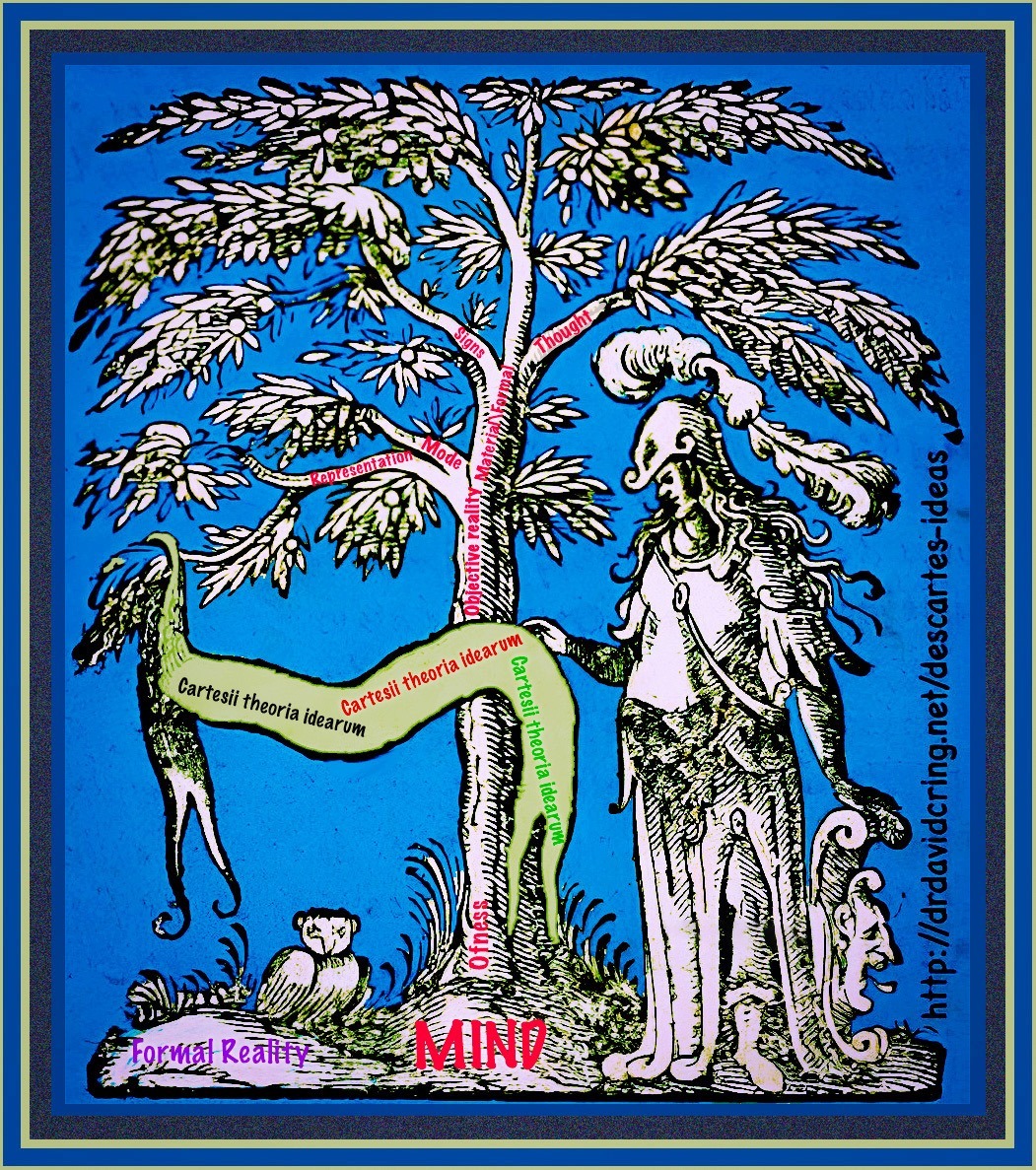 " alt="A framed color advertising graphic for DTOI website of a flowering branching tree with a female helmeted warrior to the right of the tree hold a scrolling bannner draping to left with the Latin words "Cartesii theoria idearum" written on it three times and prominent categories in the theory of ideas written on the tree.">
 " alt="The tricolored (gray, tan, and butterscotch) book cover for "Ideas and Mechanisms" the collected essays of Margaret D. Wilson.">Princeton, N.J.: Princeton University Press, 1999.
 " alt="" class="wp-image-952"/></figure>
 " alt="A transparent 28 pt. rainbow colored hexagon used as a bullet point."> Block, Ned. “Qualia.” In <a href="
 " alt="The giant white capital letter "P" logo used by PhilPapers on a dark blue background with green background to left of the "P.""></a> <a href="